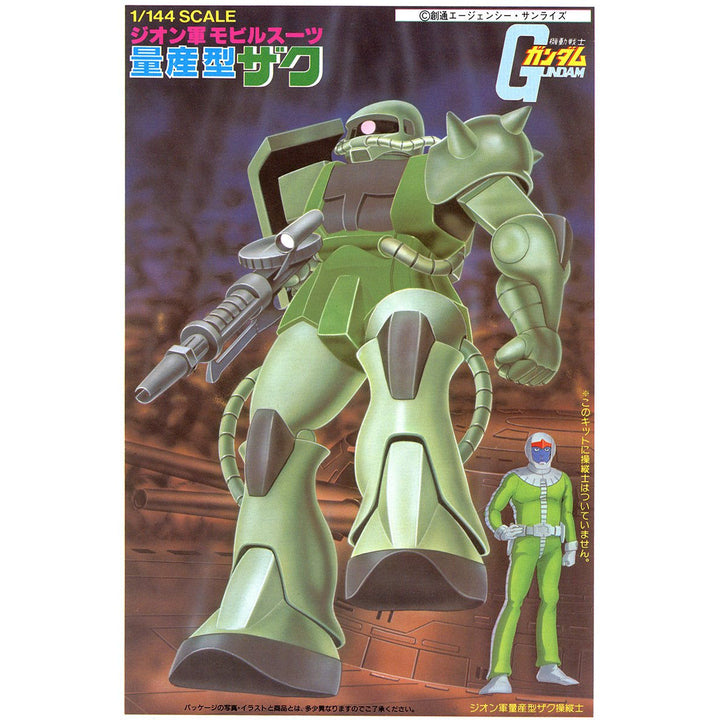
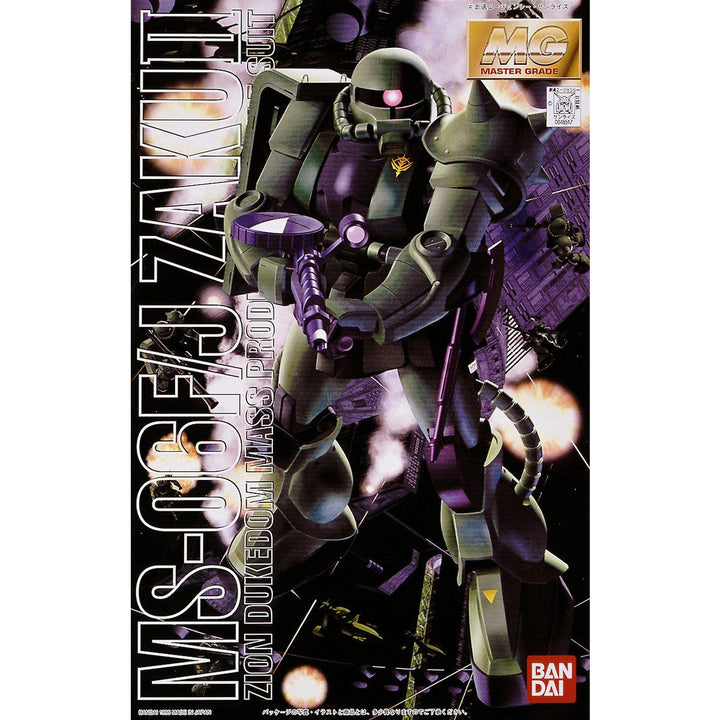
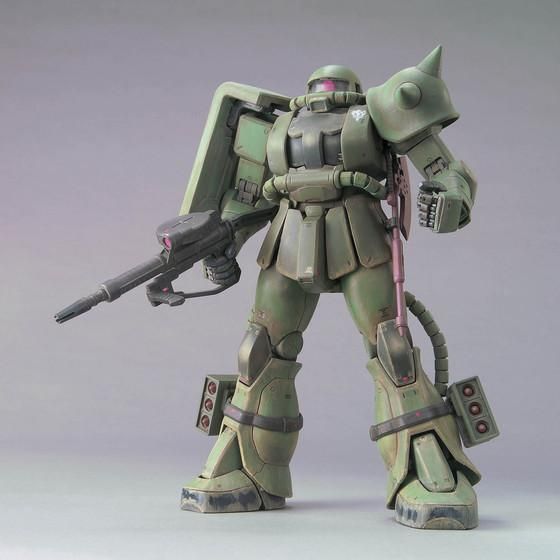
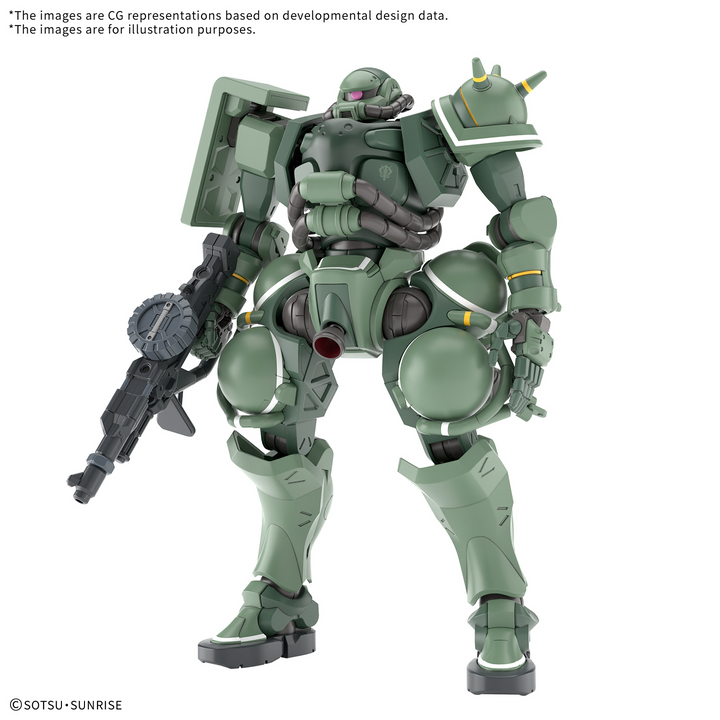
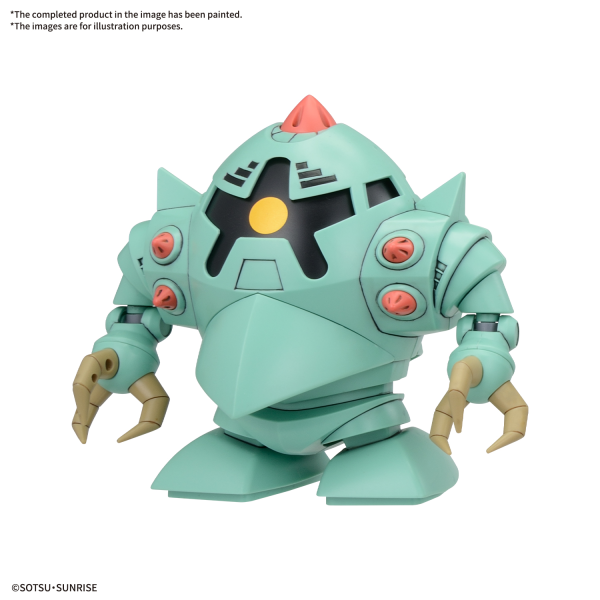
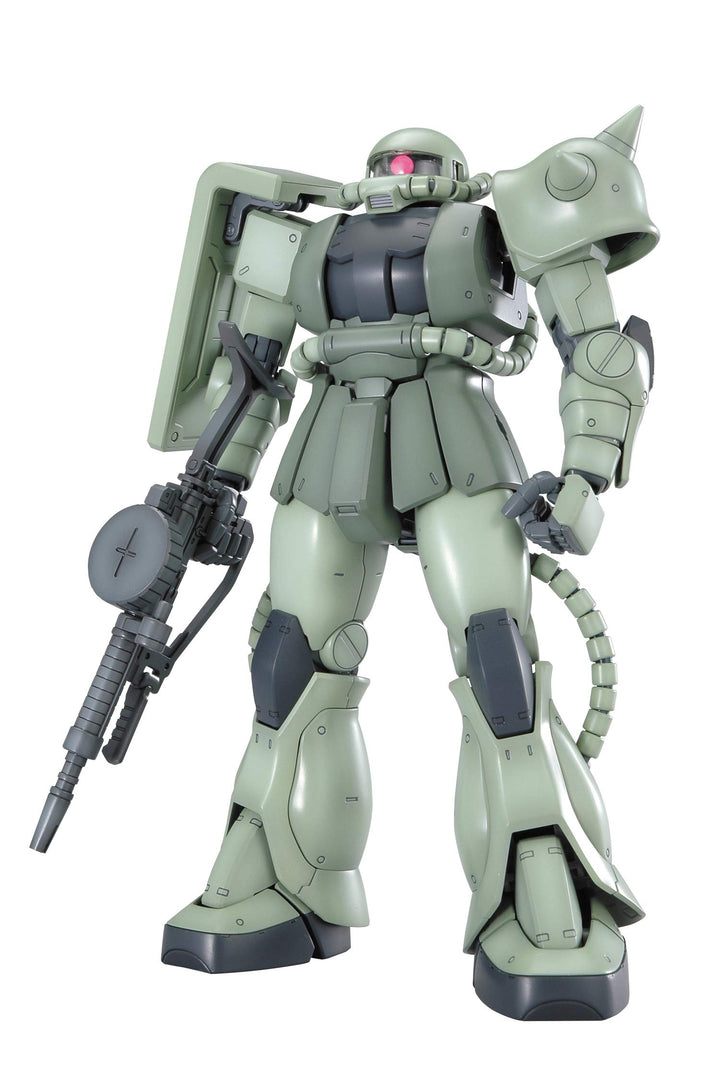
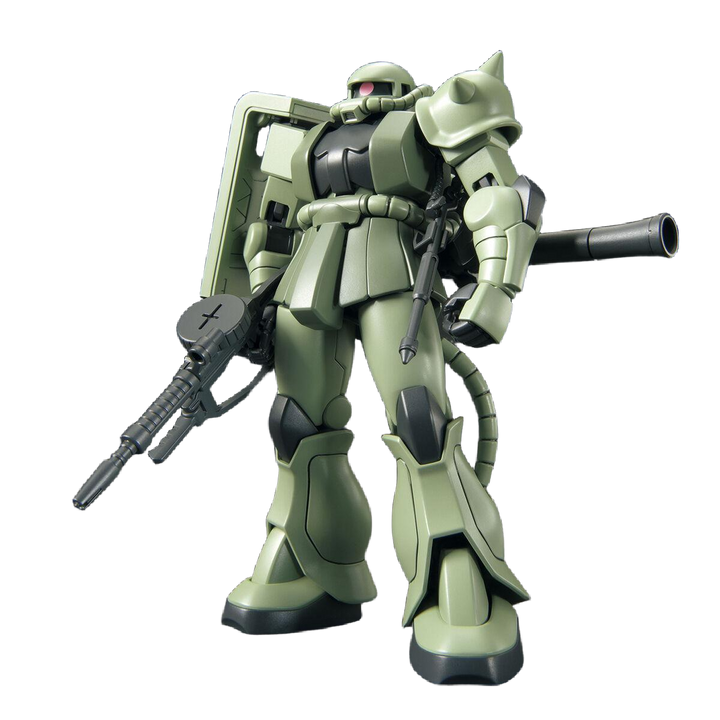
MS-06 Zaku II is the Principality of Zeon's main mass-production mobile suit in Mobile Suit Gundam (1979, U.C. 0079), and the machine the One Year War is fought with on the Zeon side. Bandai's own description singles out three identifiers: the mono-eye in the head, the mismatched shoulders with a spiked pauldron on the left and a shield on the right, and the power pipes left exposed across the body. It has no single pilot — the associated characters are the rank-and-file Zaku crews from the Side 7 reconnaissance team.
What it does in the story
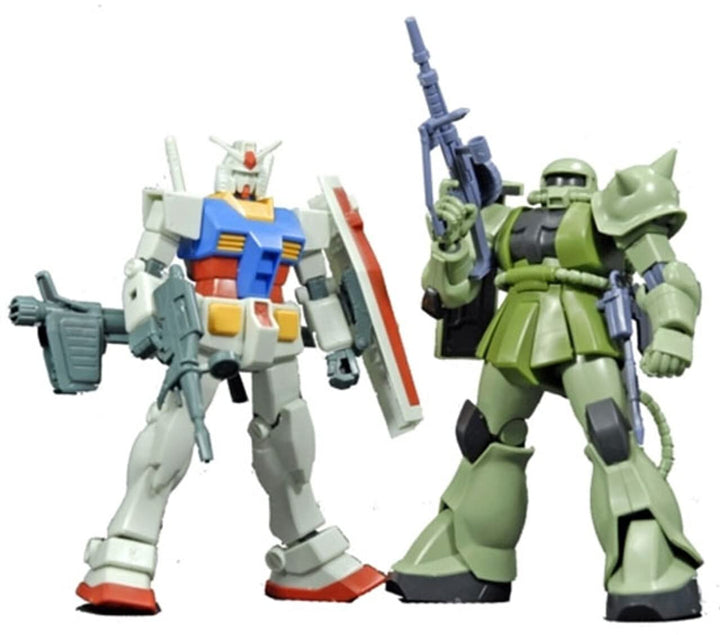
Char Aznable's Zaku team opens the series by reconnoitring Side 7 and turning the colony into a battlefield, and a civilian named Amuro Ray climbs into the Federation's prototype Gundam and drives the intruders off. It then stays Zeon's line machine for the rest of the war, carrying the bulk of the fighting while newer Federation suits close the gap.
What makes it different
-
The MS-06 is a series rather than one airframe.
The prototype rolled out in August U.C. 0077 as the MS-06A, the C type went into production in January U.C. 0078 carrying shoulder spikes, a shoulder shield and a heat hawk, and the F type became the mainstay after the Antarctic Treaty banned nuclear weapons and its radiation shielding was stripped out.
-
The F type and the J type are one suit for two battlefields.
F is the space version, with extra thrusters in the backpack, shins, calves and soles; J is the ground version, issued with leg-mounted missile pods and other surface equipment. The 1995 Master Grade kit builds either one by swapping the backpack and the foot verniers.
-
Production-kit boxes can be finished as a commander machine.
Several green Zaku II kits include a second head with the blade antenna that marked a squadron leader, so the same box builds an ordinary soldier or a commander unit. The antenna is the mark that separates a squadron leader's machine from a line suit.
-
The Zaku II's shape became the template for later Zeon suits.
Nearly every mobile suit Zeon developed up to the middle of the war belonged to the MS-06 series, and the line fed directly into post-war machines such as the RMS-106 Hizack and the AMX-011 Zaku III.
How big is it?
- 1/48 kit height: 365 mm overall on Bandai's 1/48 Mega Size kit, per the official spec
- 1/144: roughly 12 cm, scaling down from that 1/48 figure
- 1/100: roughly 17.5 cm, on the same scaling
- 1/60: roughly 29 cm, on the same scaling
Why buy from P-Rex Hobby
P-Rex Hobby is a Bandai Recommended Hobby Store with 20,000+ customers served and 1800+ five-star reviews. US orders ship duties prepaid with no import fees, and Route Package Protection is available at checkout.
Frequently asked questions
1. What actually separates the F type from the J type?
The F type is the space-fighting version, with additional thrusters in the backpack, shins, calves and soles. The J type is the ground version, with the space equipment deleted and leg missile pods issued instead, which makes it lighter and cheaper to field on Earth.
2. Is this the same machine as Char's Zaku II?
Char flies the MS-06S commander type, a separate model identified by the blade antenna on its head and finished in his own red and pink scheme. The green machines in this collection are the production F and J types, so the difference is the antenna, the colours and the tuning rather than the airframe.
3. How long was the Zaku II in service?
The prototype rolled out in August U.C. 0077, C-type production began in January U.C. 0078, and the type was still Zeon's line machine when the war ended in U.C. 0079. Two improved late-war variants, the F2 type and the FZ type, reached the front too late and in too few numbers to change that.
4. Why do the pipes sit outside the armour?
The exposed power pipes are one of the three features Bandai uses to identify the Zaku II, together with the mono-eye and the asymmetric shoulders. Bandai's description places them exposed on various parts of the body.
Background sources: MS-06 Zaku II — Gundam Wiki · ザクII(日本語版 Wikipedia)